 |
 |
|
 |
 |
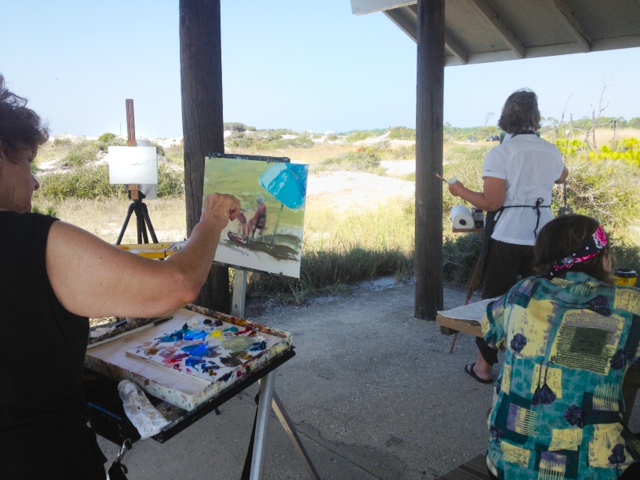
On Saturday I joined at least 16 other painters at Grayton Beach State Park, in Grayton Beach, Florida, to participate in the local effort for the Oil Painters of America 8th annual Great Paintout. It was my first try at plein air oil painting in perhaps as much as 30 years, but something I have been intending to do for a long time. I have occasionally painted outdoors using watercolors or sketched with pencil or ink, but the last time I remember painting the landscape with oils, plein air, was while on a camping vacation in St. Augustine, Florida, in 1978. That day, so long ago, was memorable for being so hot and buggy. By contrast, Saturday was the perfect day for plein air painting, being shaded by the park pavilion, and virtually bug-free.
So what’s the big deal about plein air painting, you may wonder. En plein air is French for “in open air”, a phrase used to describe painting an outdoors scene “from life”, while actually looking at it, in the often changing light and weather conditions. It requires intense concentration and awareness, and is much more challenging than painting from a photographic reference in a studio. It appeals to me in much the same way that figure drawing appeals to me, because time is a limiting factor, so one must work fairly quickly, finishing or very nearly finishing the painting in one session. For that reason, and because I felt so out of practice, I chose to paint on small 8″ x 10″ canvas boards. I managed to make a passable effort on two boards.
To a certain extent, this was a trial run for me, to see how my equipment worked, and to start remembering how to paint. I used just 3 brushes — two to paint with and a third one to sign my name, and a palette knife to scratch out some bush branches. The brush I used for most of both paintings was a Winsor-Newton #6 round, sable, I think. It worked better than the stiff bristle brushes I used a month ago in my first effort at returning to oils, in the workshop I blogged about on September 9. My new Coulter System easel and palette/box that I purchased last summer worked like a charm. I used my 35-year old Grumbacher “Pre-tested” and Rembrandt oil paints from my days doing demonstrations as a high school art teacher. My oil painting medium is about that old too, and while the paints are still good, I’m pretty sure the medium is degraded. The paintings I did Saturday are dry today, one day later, but the painting I did a month ago in the workshop, in which I used more medium, is still a little sticky.
The sand dunes at Grayton Beach are made of sand is so fine that it crunches underfoot like dry snow, and it even looks like snow in the bright sunlight, thanks to the clear crystals of quartz that make up the majority of its composition. The scrubby oak bushes and half-buried scrub pines round over the tops of the dunes, shaped away from the Gulf of Mexico by the salty seabreeze. Palmetto bushes and dune marsh grasses dot the lower dunes, fringed this time of year by various yellow wildflowers that some of us locals refer to collectively as goldenrod. I never got around to painting as much as I would like to have, never adding in the finer details of shadows and sea oats. I might go back in and put in those details, but the photos I have posted here are exactly as I finished on Saturday morning.
After we painted for about 3 hours, we all got together and looked at each others’ works, and we ooo’d and ah’d before giving feedback. It was an excellent critique, with the masters of the craft commenting on areas of paintings that worked well, and areas that were challenging, and even discussing compositional tricks, like pointing out places where something in a painting might need to recede, made difficult by being light in value. (Typically, light shapes and colors tend to advance, and darker forms recede, in a picture plane. That can be overcome by muting or graying the lighter colors, shapes tending to become less bright as they recede, the way that we see things.) Everyone was kind to me, not being critical at all, but I admit that I gave fair warning, protecting my vulnerability by explaining that I had just returned to oil painting again about a month ago, and that this was my 2nd effort in 30 years. That was a fairly clear request to cut me some slack, I think. The regular plein air painters go out every Wednesday, so if I start coming regularly, I’m sure they will feel more free to make helpful comments, and I will not be so scared to hear them.

Some of the artists who were there have their work online:
Becky Perrott
Margaret Ann Garrett
Jeanette Brooks Sherritze
Velda Dougherty
And I wish I had the names and websites of the others there — if you read my blog and know the others, please email me with their names, and I’ll include them.
Most of my images are available for purchase. Contact me if you are interested. — Joan Vienot