
An Exhibit of 60 Small Works Painted in Coastal Maine
It has been quite the adventure since my move from Northwest Florida to Downeast Maine 3½ years ago! My mission was to paint the rocky coastline, the first task being to learn how to convincingly paint rocks. My subject matter is plentiful. I also am captivated by inland landscapes. So I count it a win if my paintings include at least one rock, a challenge easily met since this is Maine!
Understanding the rocks in this part of Maine
It would have been a quick process if I had been satisfied to just paint what I saw. But I also wanted to understand what I was painting. I had not given rocks much thought since my youth. So I signed up for a local geology course during my first winter in Maine. It was taught by Duane and Ruth Braun, the geologist-authors of the excellent guidebook sold in the visitor center at Acadia National Park.
I was surprised to learn that the island home of Acadia National Park is actually the bottom part of a massive volcano that erupted some 420 million years ago during intense tectonic plate activity. In brief, 550 million years ago, Gander, the small drifting land mass that was to become much of Maine, detached from the supercontinent of Gondwana. Gander eventually bumped into and attached to Laurentia, the precursor core of North America. Another land mass named Avalon then collided with Gander on its way to becoming part of Nova Scotia. This collision caused a line of violent volcanic eruptions along the ocean-edge of Gander. At least 4 super-volcano complexes formed the coast of the region known today as Down East Maine. The volcanic activity was some of the most intense in history.
During the Ice Age, periodic mile-thick glaciers stripped more than two miles of rock from the top part of the volcano-mountains. Mt. Desert Island, where most of Acadia National Park is located, is all that remains of one of these volcanoes, ground down to a maximum elevation of 1527′ today. The island, known as MDI, is the bottom of a caldera 10 miles wide, originally ¼ the size of Yellowstone’s caldera. The rock of MDI was formed in that molten caldera, mostly granite with basalt intrusions, with outer edges of gabbro, solidified volcanic ash, and breccia. Much of the granite contains iron, giving it the pink and orange colors I so love. MDI is minutes from my home, and provides infinite inspiration for local and visiting artists.

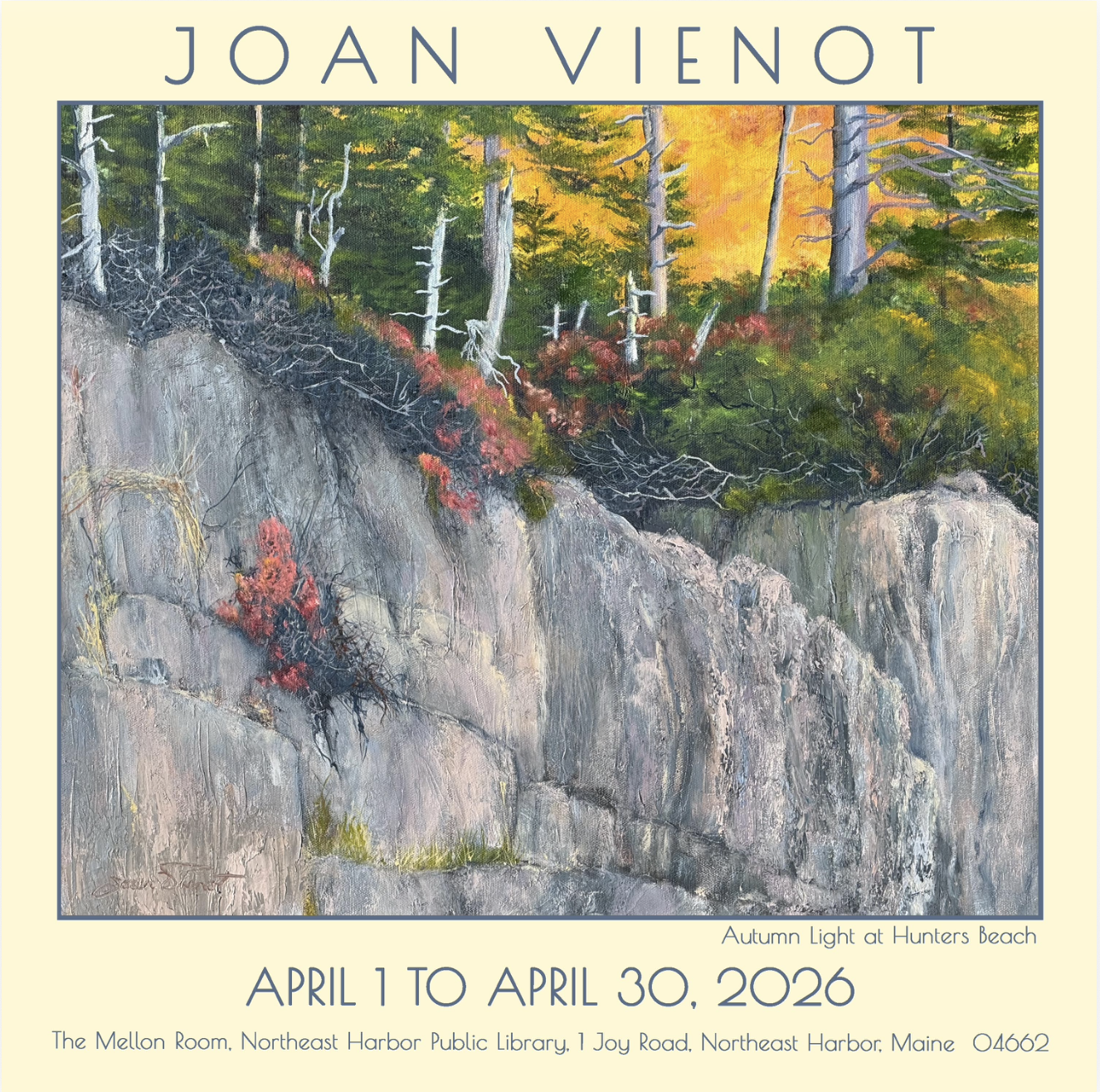
Autumn Light at Hunters Beach
Hunters Beach and the trail accessing it are owned by the Land and Garden Preserve and maintained in collaboration with Maine Coast Heritage Trust. The land is bounded by Acadia National Park on one side. The adventure starts with an easy 20-minute hike beside the beautiful Hunters Brook, sunlight filtering through the trees. The reward is a dramatic cove in the cliffs, the beach covered with cobblestones. When conditions are right, the stones roll with the wash of the waves, creating the odd crackling sound typical of cobbles.
I painted “Low Tide at Hunters Beach” below, en plein air, and it approximates the colors of the rocks as I saw them, much darker than the cobblestones. As I was picking up my easel after my plein air session, the light came over the mountain behind me and lit up the forest behind the cliff. I snapped a few photos to help me remember the exhilarating yellows and oranges of the backlighting. Nearly a year passed before I finally painted “Autumn Light at Hunters Beach” in my studio. This process of creating a painting from my memories and plein air studies and photographs is the most complete and rewarding of creative experiences in my life as an artist.

Every small community in this region has a library, and all of them support the arts. Northeast Harbor Library boasts the largest exhibit room in the area, the Mellon Room, the location of my April 2026 solo exhibit. I will display at least 60 small paintings of Coastal Maine, most of them ranging from 8×10 to 10×20. All are either framed or are painted on gallery-wrapped canvas with the painting extending around the sides. You may preview the exhibit at https://www.artworkarchive.com/rooms/joan-vienot/c3fe03. Click on the image of any painting to inquire.
On Thursday April 9 I will attend the Meet-the-Artist reception from 5:30-7:30 pm.
20% of all sale proceeds will be donated to the exhibit venue, Northeast Harbor Library, which is located at 1 Joy Road, Northeast Harbor, Maine 04662. Operating hours are 9 AM – 6 PM M-F year-round and 9 AM – 5 PM Sat., April – Nov. Occasionally the Mellon Room is booked for private use. Anyone making a special trip just to see the exhibit should call the library at (207) 276-3333 to make sure the room will be available for their visit. To see more of my work or to message me, please visit joanvienot.com. Follow me on social media at JoanVienotArt.
If you did not receive this announcement by email, please subscribe to receive my infrequent newsletters. You may unsubscribe at any time. Click HERE to subscribe.
Hi Joan, I viewed your paintings online and I am so impressed with all you have accomplished in your 3+ years in Maine. Your dedication to your studies and creativity really shine through your art. Watching your journey unfold has been such a joy. I wish I could see your exhibit in person?
Thank you, Kim, it’s a continuing adventure! You know you guys are always welcome to visit for art exhibits or just to get away for some hiking and sight-seeing!